Lippert at Caravan Salon
Lippert
Lippert at Caravan Salon 2026: a new generation of smart, modular, and connected components
With a series of innovations unveiled at Caravan Salon 2026, Lippert is taking another step in its
evolution from a component manufacturer to a provider of integrated systems. From mechanical and electronic solutions to energy management and interior components, all its new products have been developed to communicate within a single technological architecture.
This approach gives manufacturers greater design freedom, reduces production complexity, and lays the foundation for a new generation of increasingly smart, connected, and sustainable recreational vehicles.
At Caravan Salon 2026, Lippert is presenting a new generation of products that reflects the evolution undertaken by its Caravanning EMEA division – the launches represent the move from the development of individual components to that of integrated solutions in which mechanics, electronics, and connectivity work together to create a single ecosystem for recreational vehicles.
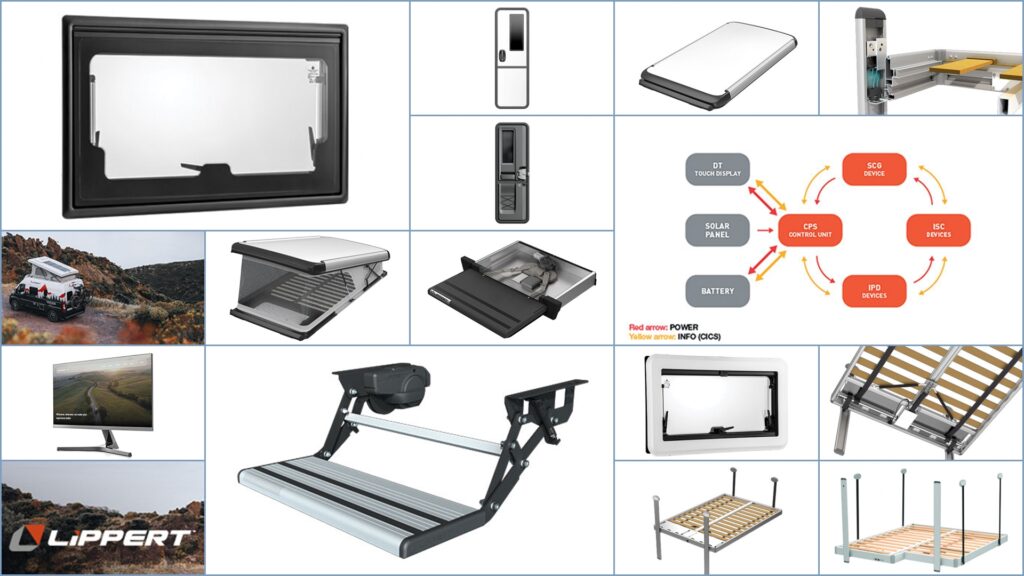
This strategy is inspired by the most advanced industries, particularly the automotive sector, where the integration of electronic systems and onboard components has become a key element in vehicle development. Drawing on its broad presence across numerous product categories, Lippert has aligned its development teams around a shared vision, with the goal of providing manufacturers with increasingly connected, modular, and interoperable solutions. Within this framework, Lippert Power Net serves as the technological infrastructure supporting many of the innovations being presented in Düsseldorf. Based on a CAN bus architecture and the new CICS standard, the platform enables components to communicate through a shared network, reducing wiring and weight, increasing design flexibility, and laying the groundwork for new features and digital services.
The main innovations presented at Caravan Salon 2026 bring this philosophy to life: from the new Vela 3.0 for the Fiat Ducato to the Nuvola and Manila Compact drop-down beds, developed around a shared modular concept, as well as the self-contained Libero step, the new Stable Door, and the Power On Board electronics range, which further expands the capabilities of the Lippert Power Net ecosystem.
Vela 3.0: the Belvedere experience comes to the Fiat Ducato
One of the most significant new products is Vela 3.0, a new pop-up roof developed for the Fiat Ducato. It brings to the most widely used base vehicle in the European campervan market all the design expertise Lippert gained from Belvedere, the elevating roof developed for the Ford Transit. The new roof retains the construction philosophy behind Belvedere, featuring a structure made from aluminium profiles and highly insulated sandwich panels.
Compared with conventional fibreglass pop-up roofs, this solution delivers a lighter, more rigid, and better-insulated product, reducing weight by approximately 35 kilograms while improving both comfort and vehicle dynamics. Designed to provide a spacious and comfortable sleeping area, Vela 3.0 incorporates a large panoramic opening and is compatible with the Vista window by Polyplastic by Lippert, as well as several tent configurations, including the new panoramic version presented at Caravan Salon. The structure has also been engineered to simplify installation during production while ensuring high standards of strength and long-term durability.
Libero: the electric step becomes fully self-contained
Among Lippert’s most original innovations is Libero, the first electric step powered by a battery that can be recharged either through a photovoltaic panel integrated into the step or by means of a charging cable. This eliminates the need to connect the step to the vehicle’s electrical system or drill through the floor. With a range of approximately 500 opening and closing cycles on a full charge, Libero can be used throughout an entire season with very little maintenance. The absence of wiring also simplifies installation during vehicle production and allows the step to be retrofitted without modifying the RV’s electrical system. The design will also support future mounting solutions in areas where battery packs will be located on batteryelectric vehicles, providing manufacturers with an innovative solution that reduces assembly time, installation complexity, and integration costs.
R-Series V3: a new iteration of one of Lippert’s best-selling steps
Lippert is debuting a new version of one of its best-selling models.
The R-Series V3 retains the same performance and dimensions while reducing weight by nearly 1.5 kg compared with the previous V2 version. This result was achieved through a redesign of the step’s kinematics and motor, which are already certified in accordance with Regulation ECE R10. The V3 introduces patented solutions that will also be extended to new versions of Lippert’s tilting steps in the future. The step is ready for market launch and will be available in silver and matte black.
Nuvola: the battery-powered bed system joins the Lippert Power Net ecosystem
Following its debut last year, Lippert has further developed Nuvola, its battery-powered system for operating electric
drop-down beds, combining it with the company’s range of Compact beds, designed to reduce overall dimensions and give interior designers greater freedom. The new structure incorporates a ladder that is fully housed beneath the bed slats, improving ergonomics and accessibility without taking up space in the living area. Nuvola is also one of the first mechanical components designed to communicate directly with Lippert Power Net, making it an integral part of Lippert’s electronic ecosystem. Integration with the onboard network opens the way to advanced control, diagnostic, and coordinated management functions in conjunction with the vehicle’s other systems.
Manila Compact: modularity becomes a design advantage
Making its debut alongside Nuvola is Manila Compact, an evolution of Lippert’s manually operated drop-down
bed. As with the motorised beds in the Compact range, the new structure delivers an average weight reduction
of approximately 15 per cent while maintaining the same levels of strength, reliability, and construction
simplicity. The traditional Manila version will remain available in the product catalogue. The main added
value lies in the shared platform developed with Nuvola. Both beds use the same structural architecture
and integration points, allowing manufacturers to develop a single furniture design and then select either a manual or electric solution depending on the vehicle’s market positioning, without modifying the cabinetry or internal structure. This modularity simplifies design, reduces industrial costs, and provides greater flexibility when creating a vehicle range.
Stable Door: a new solution for the caravan market
Lippert is renewing its offering in the Stable Door segment, a traditional split-door design that is particularly popular in the caravan market. Divided horizontally into two independent sections, the door allows users to open only the upper half, improving ventilation and natural light inside the vehicle while keeping the lower section closed. This practical solution maintains a physical barrier between the interior and exterior, helping prevent pets or small children from leaving the vehicle while improving comfort. The new Stable Door is also available with finishes coordinated with the vehicle’s sidewall, allowing manufacturers to integrate it seamlessly into the
caravan’s design and expand the available aesthetic customisation options.
Piuma: integrated design, lightweight construction, and easy installation
Piuma is Polyplastic by Lippert’s fully integrated window system, designed to combine contemporary styling, lightweight construction, and installation efficiency. The system includes a polymer frame, double-pane
cast acrylic window, integrated blind system, interior finish, and integrated mounting clamps, delivering a complete solution with an exceptionally flush and minimalist appearance. Thanks to its integrated mounting concept, installation is quick and straightforward, while the automatic aluminium stays allow the window
to be opened and secured in any position. Dedicated locking catches with a night-ventilation function further enhance onboard comfort while ensuring reliable protection.
Piuma is part of Polyplastic’s extensive window portfolio, which addresses a wide range of vehicle design requirements through three main product categories: hinged window systems, aluminium-frame window systems, and polymer-frame window systems, alongside special solutions developed to meet specific OEM requirements.
Power On Board: a complete ecosystem for energy management and onboard services
Demonstrating that Lippert Power Net is not merely a communication platform but an infrastructure already supported by a broad range of products, Lippert is once again presenting its complete portfolio of electronic systems for energy management and onboard services at Caravan Salon. The range includes DC-DC boosters, which optimise battery charging while the vehicle is in motion, including on Euro 6 vehicles equipped with smart alternators; highefficiency battery chargers compatible with lead-acid, AGM, and lithium batteries; and
electronic control units (Electroblocks), which form the core of the electrical system by managing power distribution, protecting circuits, controlling battery charging, and coordinating the power supply to all onboard devices.
The offering also includes intelligent power supply units that automatically manage all available power sources, optimising energy distribution and battery charging without requiring any action from the user; solar charge controllers that optimise the output of photovoltaic panels and simultaneously charge both the service battery and the engine battery; and electronic lighting-control systems capable of managing switching, dimming, and lighting scenarios. Control panels and displays are available in both traditional versions and with a 7-
inch touchscreen, enabling users to manage batteries, tanks, water pump, climate control, lighting, and numerous other vehicle devices from a single interface.